
Hip to Gable Loft Conversions — Costs, Planning & Plans
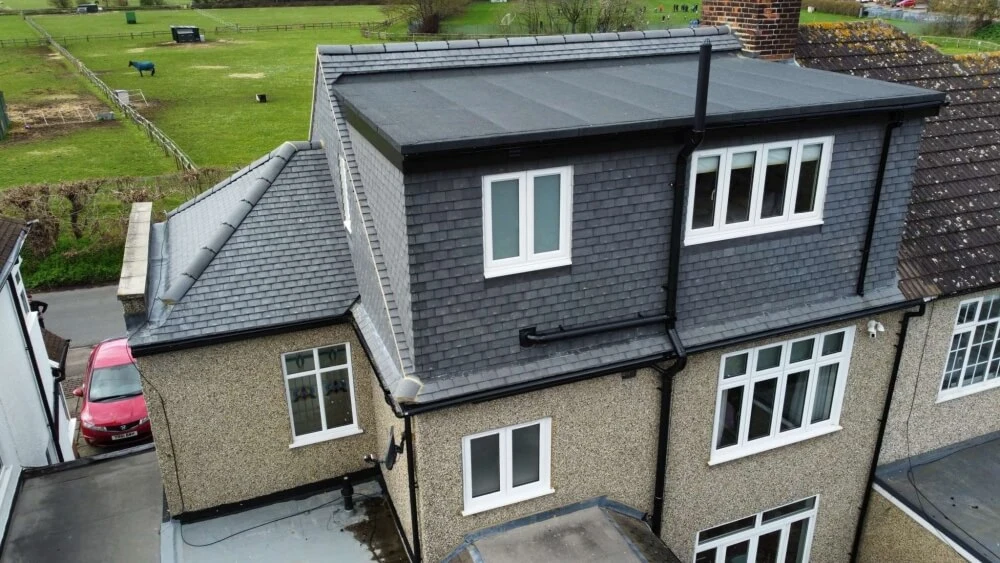 Project reference · Hip to Gable Loft Conversions
A hip-to-gable loft conversion extends the sloping side of your roof outward and replaces it with a vertical gable wall — turning a cramped loft into a full-height room with serious floor area. It's the go-to conversion for semi-detached, detached and end-of-terrace homes with a hipped roof, and one of the highest-returning improvements you can make to a UK property. On the right house it unlocks enough usable space for a proper master bedroom and en-suite, often with a walk-in dressing area or built-in eaves storage on top. Here's everything you need to know — current starting build costs, the planning rules, the design process, the design choices that matter, and what our drawings and planning package covers.
1–2 Week Drawing Preparation
Planning or LDC drawings and the submission are prepared in approximately 1–2 weeks after survey. External review periods are separate.
Why homeowners choose Loft Plans
Drawings, structural calculations and planning submissions delivered as one fixed-price package — no hidden extras from us. Council, statutory and building-control fees are separate.
What's included in the full package
The planning/design stage is £950. On full-planning cases, the £550 technical stage follows approval, making the coordinated package £1,500.
- Site survey and full measure-up
- Planning or LDC drawings and submission in approximately 1–2 weeks
- Building regulations drawings — structural, fire, insulation, ventilation
- Structural calculations prepared by a structural engineer
- Lawful Development Certificate or full planning application
- Full liaison with your local authority until decision
- Drawings and calculations packaged for your builder and building control
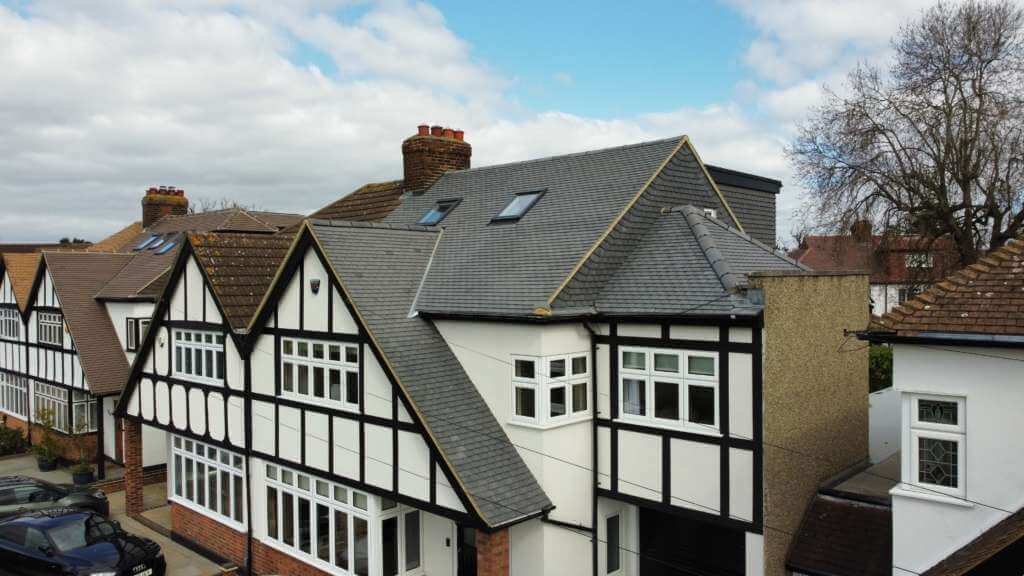
Recent project — Upminster
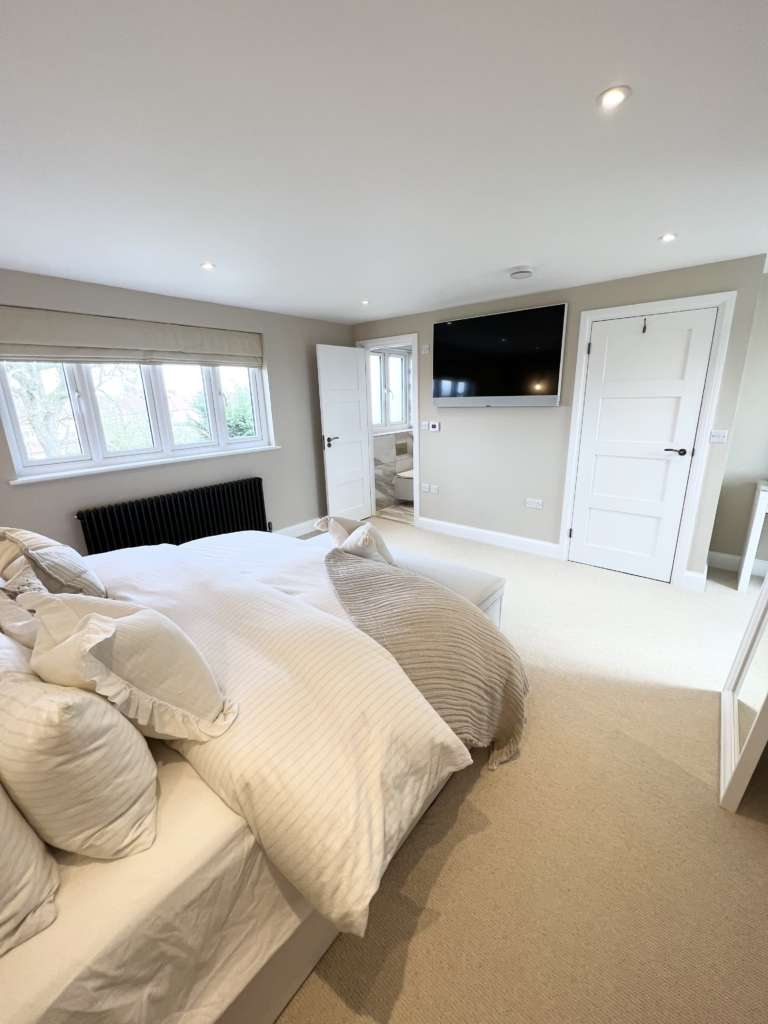
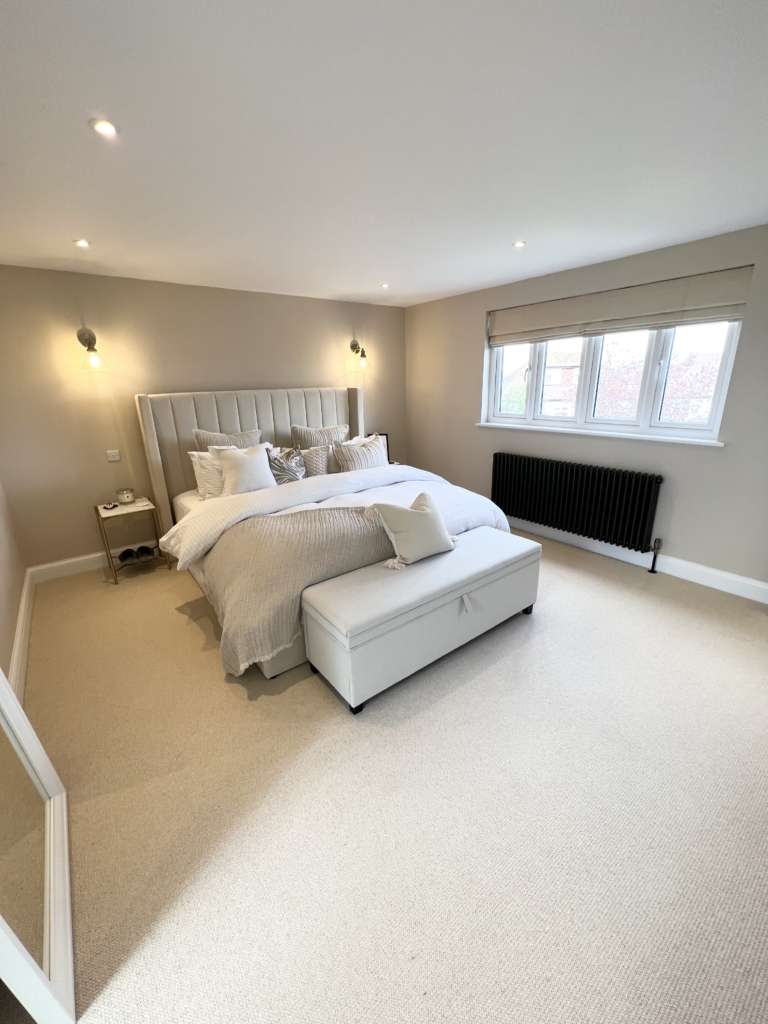
Photos from a hip-to-gable conversion in Upminster — master bedroom, walk-in wardrobe area and en-suite, completed alongside a full roof replacement.
How it works
- 01
Survey
We visit, measure up and confirm a hip-to-gable is the right conversion for your roof.
- 02
Drawings
We prepare the drawings and relevant submission in approximately 1–2 weeks.
- 03
Planning
We submit the LDC or full planning application and handle all council liaison.
What is a hip-to-gable loft conversion?
Most semi-detached, detached and end-of-terrace homes have a 'hipped' roof — the side that slopes inward from the eaves to the ridge. That hipped slope is what makes the loft feel cramped and unusable: you lose all the head height on the side that should be your floor area. A hip-to-gable conversion solves this by removing the sloping hip section and building a vertical brick or timber-framed gable wall in its place, then extending the main roof out over it. The result is a rectangular loft with full standing head height across nearly all of the floor area — typically enough for a proper double bedroom, often with room for a built-in en-suite. It's the standard, proven conversion for any house with a hip. On a semi-detached you convert one side; on a detached you can convert both sides for a 'double hip-to-gable', which doubles the new floor area but also doubles the cost.
The benefits — why people choose hip-to-gable
On a hipped house, hip-to-gable is the conversion that genuinely transforms what's possible upstairs. Here's what you gain:
- Far more usable floor area — converting the hip typically adds 6–9 m² of head-height space on top of what a plain dormer gives you
- Full standing height across the room — no awkward sloping wall where your bed or wardrobe needs to go
- Easier, more comfortable staircase — the new gable wall lets the staircase land cleanly inside the loft with proper head height
- A real window in the gable — proper standing-height windows instead of sky-only Velux rooflights
- Curb appeal — done right, the new gable end looks like it was always part of the house
- Best value-add per pound — consistently sits at the top of the loft-conversion value-uplift range
How much does a hip-to-gable conversion cost?
These are indicative build starting prices only. Final construction cost depends on size, specification, structural complexity, access and location. Your appointed builder provides the final quotation; Loft Plans provides the design, planning and technical package.
- Hip-to-gable — from £35,000
- Hip-to-gable with rear dormer — from £45,000
- Double hip-to-gable with dormer — from £55,000
Will it fit my house?
Hip-to-gable works on any home with a sloping hip on at least one side. It does NOT suit mid-terrace homes — they almost always have gable walls on both sides already, so there's no hip to convert. Mid-terrace owners go straight to a rear dormer or L-shape dormer. You also need enough existing ridge height. We measure this on the survey: from the existing ceiling joists to the underside of the ridge should be at least 2.3m for the conversion to work without raising the roof. Almost all post-war hipped homes have it.
- Semi-detached houses — the most common case, one hip on the outer side
- Detached houses — usually two hips, so either single or double conversions
- End-of-terrace houses — one hip on the outer end
- Bungalows — single-storey hipped homes are excellent candidates; the new loft adds a whole second storey
Ideas for the new room — what you can actually fit
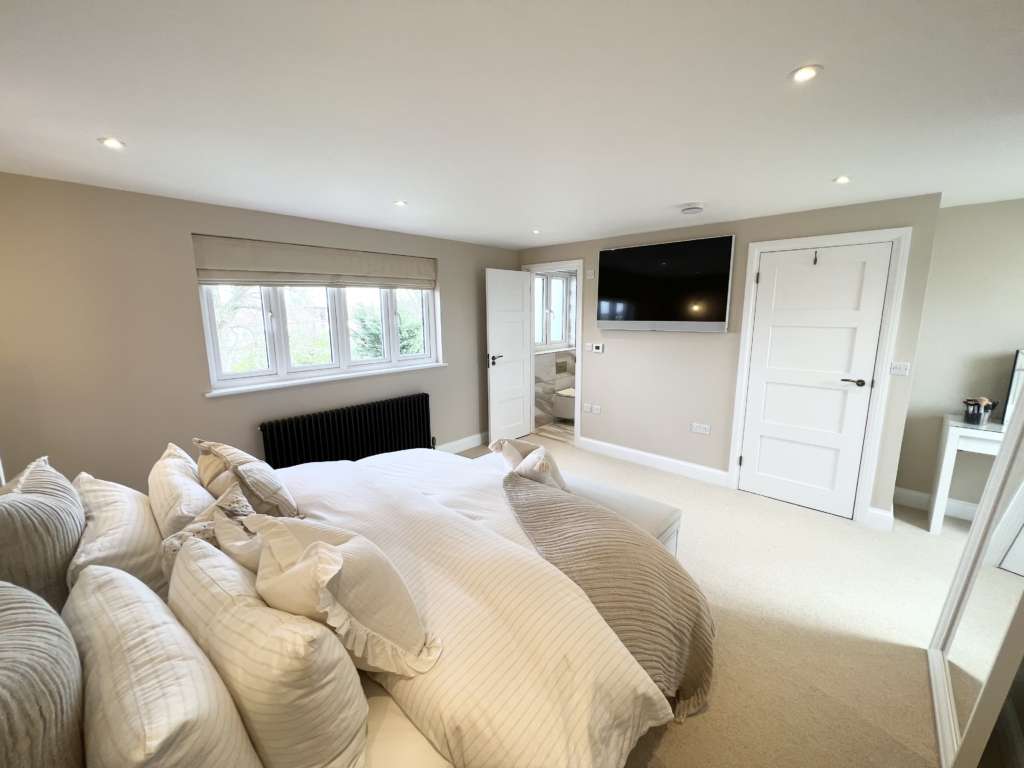
Because a hip-to-gable creates a properly rectangular room with head height, you're not boxed into one layout. We sketch the layout with you at the survey, so you can see how the bed, wardrobes, en-suite and staircase land before we commit anything to the planning drawings.
- Master suite with en-suite and dressing area — by far the most popular layout
- Two children's bedrooms — works best on detached homes or larger semis with generous floor plates
- Master bedroom + dedicated home office — bedroom on the gable side, office in the rear dormer
- Self-contained guest suite — bedroom, en-suite and a small sitting nook; a strong selling feature
- Open studio / hobby room — yoga, music, art, home gym or library; one large flexible space
Design and application process
After the survey, we prepare the drawings and relevant submission in approximately 1–2 weeks. For a suitable Permitted Development project, Building Regulations drawings and structural calculations can be prepared in that same design period. For full planning, the standard statutory determination period for a typical householder application is usually 8 weeks, although councils can take longer; after approval we finalise the technical package within a further few working days. Council, building-control and construction timing are external. You appoint your own builder.
Hip-to-gable vs other conversion types
| Conversion type | Starting build cost | Construction timing | Planning |
|---|---|---|---|
| Velux (rooflight) | From £30,000 | Set by your builder | Often Permitted Development |
| Rear dormer | From £40,000 | Set by your builder | Often Permitted Development |
| Hip-to-gable | From £35,000 | Set by your builder | Often Permitted Development |
| Hip-to-gable + rear dormer | From £45,000 | Set by your builder | Route checked per property |
Indicative build starting prices only. Final construction cost depends on size, specification, structural complexity, access and location; your appointed builder provides the quotation and programme.
Not sure which conversion suits your loft?
We’ll assess the roof and explain what the space can realistically deliver.
Party wall agreements — what adjoining owners need to know
Party wall matters can apply where work affects a shared wall. This is separate from Loft Plans' design, planning and technical service. We do not serve notices or control that timetable; obtain advice and a separate quote from a party wall professional where needed.
Planning permission — Permitted Development in most cases
Hip-to-gable conversions are usually allowed under Permitted Development, which means no planning application is required. To qualify the conversion must meet these conditions:
- Stay within the volume limit — 40 m³ added for terraces, 50 m³ for semi-detached and detached
- Not extend beyond the existing front elevation
- Not go above the existing roof ridge line
- Use materials similar to the existing roof and walls
- Have obscure-glazed side-facing windows
- Not include roof terraces, balconies or raised platforms
Building regulations — what you'll need to satisfy
Every loft conversion needs building regulations approval, regardless of planning. This is what makes the loft legally a habitable room. Our package includes all of the building regulations drawings and structural calculations. Your builder calls building control inspections at the key stages and they sign each one off in turn.
- Structural — new joists across the loft, steel beams to support them, and a properly tied-in new gable wall
- Fire safety — 30-minute protected staircase enclosure, fire-rated doors, mains-wired interlinked smoke alarms
- Means of escape — escape windows where the protected route can't be guaranteed
- Thermal insulation — full insulation to current Part L energy efficiency standards
- Stairs — minimum 2m head height, maximum 42° pitch
- Ventilation — trickle vents on windows, mechanical extract in any new bathroom
Construction follows the completed design pack
Your appointed builder plans and carries out the construction, including temporary protection, structural work, roof and dormer framing, services, stairs, insulation and finishes. Building control reviews the technical information and inspects the work. The builder controls the programme and completion date; Loft Plans does not carry out or programme construction.
Hip-to-gable vs other conversion types
If you have a hipped roof, hip-to-gable is almost always worth doing because it unlocks the head height — without it the loft is hard to use no matter what you do.
- vs Velux — cheaper but only works if you already have head height. On a hipped roof you usually don't, which is why hip-to-gable is the unlock.
- vs Standard rear dormer — gives head height at the back but leaves the side cramped. Combining hip-to-gable with a rear dormer is the standard solution.
- vs L-shape dormer — only works on houses with a back addition (typical Victorian/Edwardian terraces). Hipped semis don't have that.
- vs Mansard — a more extensive roof rebuild that usually needs full planning permission and starts from £70,000 for construction.
Why work with a specialist designer rather than a general architect
Hip-to-gable conversions require careful coordination between planning limits, staircase layout, structural details and Building Regulations information. Our specialist service brings those documents together for council and building-control review. We prepare the planning or LDC drawings and submission in approximately 1–2 weeks after the survey.
Areas we cover
We design and submit hip-to-gable loft conversions across Essex, London and Hertfordshire — including:
Frequently asked questions
01What is a hip-to-gable loft conversion?
A hip-to-gable conversion extends the sloping 'hip' side of your roof outward and builds a vertical gable wall in its place. That single change turns a cramped triangular loft into a much larger rectangular space with full standing head height — usually enough for a proper double bedroom, often with an en-suite. It's the standard conversion for semi-detached, detached, and end-of-terrace homes with a hipped roof.
02How much does a hip-to-gable loft conversion cost in 2026?
A hip-to-gable build starts from £35,000; with a rear dormer it starts from £45,000; and a double hip-to-gable with dormer starts from £55,000. Final construction cost depends on size, specification, structural complexity, access and location. Loft Plans does not carry out construction.
03Do I need planning permission for a hip-to-gable conversion?
Usually no. Hip-to-gable conversions are normally allowed under Permitted Development on semi-detached, detached and end-of-terrace homes, provided you stay within the volume limit (40 m³ for terraces, 50 m³ for semis and detached), use materials similar to the existing roof, and don't extend beyond the original front elevation. Flats and listed buildings do not benefit from the same householder loft Permitted Development route and need separate planning and consent checks. Conservation areas and National Landscapes have tighter restrictions, and an Article 4 direction can remove specific Permitted Development rights — so the right route should be checked for your property before submission. We recommend applying for a Lawful Development Certificate even when planning isn't required — it's the legal proof you'll hand to a buyer's solicitor when you sell.
04Can a mid-terrace house have a hip-to-gable conversion?
Only if your roof has a hip on the side (rare for mid-terraces). Most mid-terraces have gable walls on both sides already, so there's nothing to convert — those homes go straight to a rear dormer or L-shape. Hip-to-gable is the right conversion when you have a sloping side roof, which is overwhelmingly semi-detached, detached and end-of-terrace properties.
05How long does a hip-to-gable take on site?
After the survey, Loft Plans prepares the drawings and relevant submission in approximately 1–2 weeks. The standard statutory determination period for a typical householder application is usually 8 weeks, although councils can take longer. Construction timing is set by your appointed builder.
06Will the new gable wall match the rest of the house?
Yes — building regulations and Permitted Development both require the new gable to match the existing roof and walls in material and appearance. On a brick house the gable is built in matching brick; on a rendered house it's rendered to match. Tiles on the extended roof are matched to the existing ones as closely as possible. From the street the conversion should look like it's always been there.
07Do I need a party wall agreement?
If you're end-of-terrace or semi-detached, yes — the Party Wall Act requires you to serve notice on adjoining neighbours before any work affecting the shared wall, including bedding steel beams into it. A party wall surveyor handles this; costs vary, so obtain a separate quote if a surveyor is needed. Detached homes usually skip this step.
08Can I have a hip-to-gable on a bungalow?
Yes — bungalows are excellent candidates. A hipped bungalow has a low roofline with all four sides sloping inward, so converting one or both hips and adding a rear dormer can effectively add a whole new storey of living space. It's one of the most transformative loft conversions you can do because you're often doubling the home's footprint of usable space, not just topping it up.
09Will I lose much floor space to the new staircase?
Usually no more than about 2 m² on the floor below — typically taken from a landing or a corner of a bedroom. The big advantage of a hip-to-gable is that the new vertical wall gives you the head height to land the staircase comfortably inside the loft itself, which often isn't possible in an unconverted hipped roof. Staircase position is one of the first things we work out at the design stage to minimise disruption to the floor below.
10Can I have windows in the new gable wall?
Yes — and it's one of the best parts of a hip-to-gable. The new vertical gable is the perfect place for a large window (or pair of windows), flooding the room with natural light and giving you a proper view rather than a sky-only Velux. Side-facing gable windows need to be obscure-glazed and non-opening below 1.7m under Permitted Development, but a window high in the gable can be clear glass.
11What can I use the new room for?
Most clients build a master bedroom suite — double bedroom plus en-suite shower room, often with fitted wardrobes in the eaves. Other popular layouts: two smaller children's bedrooms (where head height allows), a single bedroom plus a home office, a self-contained guest suite, or a large open-plan studio for working from home, yoga or hobbies. The hip-to-gable gives you enough usable floor area that you genuinely have options.
Explore other conversion types
The technical drawings building control need before work starts.
Engineer-designed beams and joists for your conversion.
The complete story behind the photos above — brief, scheme, planning route and outcome.
Browse every loft conversion we've drawn and submitted.
The most popular conversion type — full standing head height, mid-range cost.
Maximum-space conversion for Victorian and Edwardian terraces with a back addition.
The simplest and cheapest route — no dormer needed.
Full 2026 cost breakdown across every conversion type.
Ready to plan your loft conversion?
Tell us about the property and receive a clear, fixed-price scope for the design stage.