Do I Need Planning Permission for a Loft Conversion?
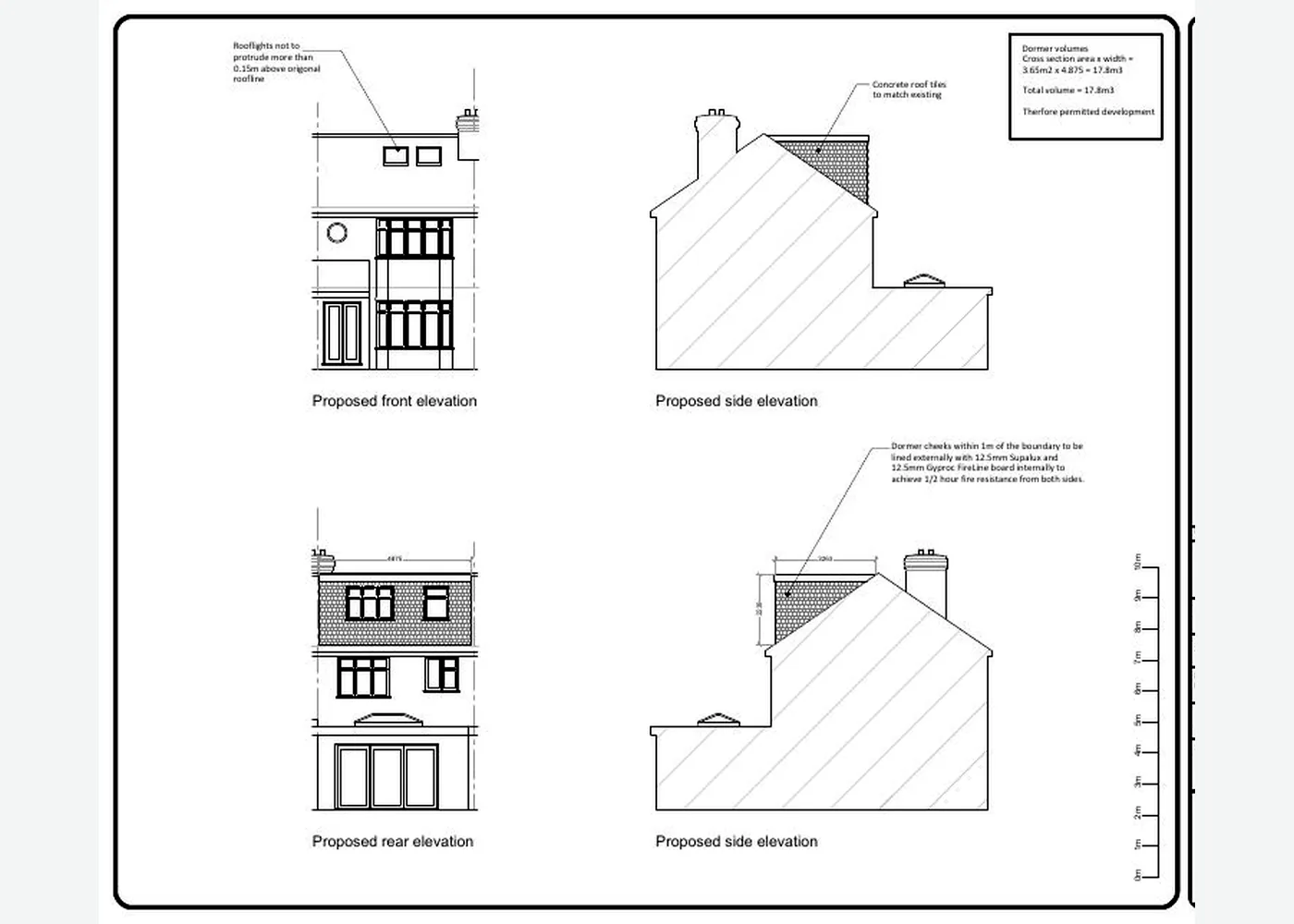 Planning evidence · proposed elevations
Many house loft conversions in England can be built without a planning application, as Permitted Development — but only if every relevant limit and condition is met and the rights haven't been removed for your property. Here's how the rules work, when a full application is needed, and where a Lawful Development Certificate fits in.
Permitted Development: how it works
In England, householder roof enlargements such as dormers and hip-to-gable extensions can fall within Permitted Development under Class B of Part 1, Schedule 2 of the General Permitted Development Order. Other roof alterations, such as rooflights, fall under Class C. Both apply only to houses, and only when all the limitations and conditions are met. The main Class B limits include: • A volume allowance of 40 m³ for terraced houses and 50 m³ for other houses — previous roof enlargements count towards this • No enlargement of a roof slope that forms the principal elevation and fronts a highway • No part higher than the highest part of the existing roof • Materials similar in appearance to the existing house • Side-facing windows obscure-glazed and non-opening below 1.7 m above the floor • No verandas, balconies or raised platforms • Enlargements generally set back at least 20 cm from the original eaves, where practicable
Front roof slopes and rooflights
A dormer or other enlargement on a principal-elevation roof slope that fronts a highway can't be built under Class B. Rooflights on that slope may instead fall under Class C, provided they don't protrude more than 15 cm beyond the roof plane, aren't higher than the existing roof, and any side-facing ones meet the obscure-glazing condition. If you want a front dormer, a householder planning application is the usual route.
When Permitted Development may not apply
Some properties and locations need extra care: • Designated land — Class B roof enlargements aren't permitted in conservation areas, National Parks, National Landscapes (AONBs), the Broads or World Heritage Sites • Article 4 directions can remove householder rights locally, so check with your council — they are more common in parts of London • Flats and maisonettes don't have the same householder Permitted Development rights • Listed buildings need listed building consent for most alterations • Conditions on an earlier planning permission can remove Permitted Development rights If any of these apply, a householder planning application is usually needed. We design and submit either way.
Not sure which conversion suits your loft?
We’ll assess the roof and explain what the space can realistically deliver.
Lawful Development Certificates (LDC)
A proposed Lawful Development Certificate is formal confirmation from your local planning authority that, based on the drawings and information submitted, the proposed work would be lawful without planning permission. It isn't planning permission, it only covers what was applied for, and the work needs to be built as shown. It isn't compulsory, but it gives you clear, formal evidence of the position before you build, which is useful when selling or remortgaging. In England the statutory fee for a proposed LDC is generally half the equivalent full planning application fee, and an online service charge may also apply. Fees change, so we confirm current fees before submitting.
Building regulations always apply
Whatever the planning route, every habitable loft conversion needs building regulations approval. For a suitable Permitted Development project, we can prepare the Building Regulations drawings and structural calculations within the same approximately 1–2 week design period as the LDC package. For a full-planning case, we finalise the technical package within a further few working days after approval. Building-control review is separate.
Every property is different
This guide is a general overview, not legal advice. Whether your loft can be Permitted Development depends on the house, its location, previous alterations and planning history. We check these for your property before drawing, and where the position is uncertain a Lawful Development Certificate or a householder application gives you a formal answer.
Frequently asked questions
01Do I need planning permission for a loft conversion?
Not always. In England, many house loft conversions can be carried out as Permitted Development, without a planning application, if they meet every relevant limit and condition in Class B (roof enlargements) or Class C (other roof alterations such as rooflights) of the General Permitted Development Order, and the rights haven't been removed. Flats and maisonettes, designated land such as conservation areas, Article 4 areas and some properties with restrictive planning conditions usually need a householder planning application instead.
02What is Permitted Development?
Permitted Development rights are set nationally and allow certain householder works without a planning application. For loft conversions the relevant rules are Class B and Class C of Part 1, Schedule 2 of the General Permitted Development (England) Order 2015, as amended. The rights come with detailed limitations and conditions, and they can be restricted locally.
03What's a Lawful Development Certificate?
A proposed Lawful Development Certificate is formal confirmation from your local planning authority that, based on the drawings and information submitted, the proposed work would be lawful without planning permission. It isn't planning permission, it only covers what was applied for, and the work must be built as shown. It isn't compulsory, but it gives you clear evidence of the position, which is useful when selling or remortgaging.
04Do previous extensions affect my allowance?
Yes. The 40 m³ (terraced) and 50 m³ (other houses) volume allowances include any previous roof enlargements to the house, including those by earlier owners. Other earlier works, and conditions attached to past planning permissions, can also affect what is allowed.
05Can I put a dormer on the front of my house?
Not under Permitted Development if the roof slope forms the principal elevation and fronts a highway — Class B doesn't allow enlargement of that slope. Rooflights on the front slope may be possible under Class C if its conditions are met. A front dormer would need a householder planning application.
06How long does it take?
We prepare planning or LDC drawings and the submission in approximately 1–2 weeks after the survey. For a typical householder planning application, the standard statutory determination period is usually 8 weeks, although councils can take longer. LDC decision times also sit outside our preparation period and vary by authority.
07How much is the LDC fee?
In England the statutory fee for a proposed Lawful Development Certificate is generally half the equivalent full planning application fee. An online submission service charge may also apply. Fees change, so we confirm the current amount before submitting; it is paid by you.
08Do I still need building regulations approval?
Yes. Every loft conversion that creates a habitable room needs building regulations approval, whatever the planning route. This covers structure, fire safety and escape, stairs, insulation and ventilation.
09Do I need to notify my neighbours?
If your home is semi-detached or terraced, the Party Wall etc. Act 1996 will often require notice to adjoining owners before certain work starts. This is separate from planning and building regulations.
Related services
How we check, draw and submit a proposed LDC for your loft.
Survey and drawings for an LDC or householder planning application.
The professionals and specialist services that can prepare loft conversion plans.
Ready to plan your loft conversion?
Tell us about the property and receive a clear, fixed-price scope for the design stage.